
*Why We Do What We Do in Life and. . .*
I typed ‘motivation’ into Amazon.ca’s little white box and it offered me over 100,000 titles. ‘Psychology of motivation’ reduced the number to over 50,000 titles.
But you don’t need me to tell you how pervasive the concept of ‘motivation’ is in all fields of study and explanation of human behavior.
Somewhere along the path of life, I encountered the phrase, “There is a reason for everything.” It stuck with me.
When I saw an expression of anger by a customer at a sales checkout stand, I could temper my internal response with that phrase. How could I know what was going on in that person’s life at that moment? There was a reason for a loss of emotional control.
You can think of your own examples, probably even from today. And, if you haven’t ‘left the house’ yet to encounter another human being, you likely have been an example yourself in some way.
Think about it. There is a reason for everything. Keeping that phrase close at hand just might allow me (and perhaps you as well) to walk through a day with more compassion and mercy.
The power of habit.
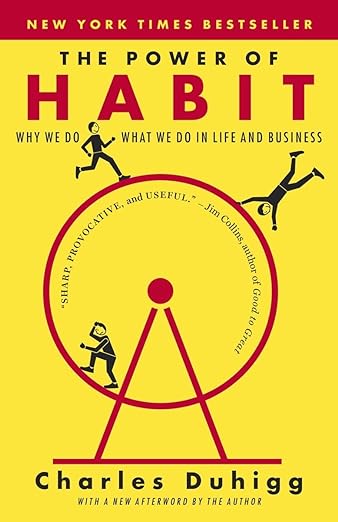
But there is good news! You don’t have to cycle through 50,000 or more items. People like Charles Duhigg have created models of understanding and behavioral change to help us. In The Power of Habit, Duhigg addresses three circles of habits starting with individuals, then organizations, and finally, societies.
My interest here is the primary context of individuals. That means me and you.
After describing new learning from two medical case studies of men named ‘E.P.’ and ‘H.M.,’ Duhigg outlines what he calls ‘the habit loop.’ It’s a pretty straightforward process in our brain that unfolds in three steps:
- Cue – is a trigger “that tells your brain to go into automatic mode and which habit to use.”
- Routine – is the physical, mental or emotional sequence we go through in response to the cue.
- Reward – is the end result; the strength of our interest in the reward will influence the brain’s level of assessment as to whether this particular loop is worth remembering for next time.
The marketing of consumer products is totally invested in cultivating these habit loops. Duhigg describes how Pepsodent toothpaste ‘rocked its world’ in the early 1900’s.
Dental care was so non-existent that “when the government started drafting men for World War I, so many recruits had rotting teeth that officials said poor dental hygiene was a national security risk.” However, by 1930, the crafting of a crafty habit loop created the daily brushing ritual for most of the American people. How did they do that?
The cue was marketed as “Run your tongue across your teeth. . . you’ll feel a film. . . that’s what makes your teeth look ‘off color’ and invites decay.” The reward, after the simple routine of a quick brush with Pepsodent, was a prettier smile. And so, the use of toothpaste in America went from 7% to 65% of the population.
Claude Hopkins, the instigator of the Pepsodent tsunami, became rich and pontificated two basic rules of human psychology: First, find a simple and obvious cue (e.g., tooth film); and second, clearly define the rewards (e.g., beautiful teeth).
Hopkins’ rules, even today, “are a staple of marketing textbooks and the foundation of millions of ad campaigns.”
If you find this drama interesting, check out the equally fascinating story of how Procter and Gamble moved Febreze from the dustbin of obscurity to the front shelf in the laundry room of every home in America.
So what good is all of this to you and to me? Well, our interest – at least my interest – is “How can I create new habits?” How can I change patterns of my behavior to move in new directions? How can I get rid of behavior patterns that are no longer (or never were) desirable? Duhigg has more good news.
With the assistance of rats and monkeys, researchers have established that the sight (or sound, or any of the senses) of the cue stimulates a craving which then jumpstarts the routine towards the reward. Seeing an enticing food ad on television sends us to the fridge or Uber Eats, Skip the Dishes. . . you know what I mean.
The Marlboro Man had the power to raise many a man (and woman too) from their couch to grab a smoke. The chime of a new text coming in causes many cell phones to be balanced on knees under the table during meetings. The list goes on and on.
So, what’s the good news?
In its utter simplicity, it is – Revise the craving! Bring the reward to the front of the bus. Frame it as a cue that inspires our motivation. Allow it to gently nourish a new craving.
So, I go to the gym (or jog, or eat more healthy food, or. . .) more regularly not for some vague future promise of goodness but for the fantastic reward of feeling so good at the end of today. To know that I spent a whole day doing better than I did yesterday gives me a euphoric sense of wellbeing.
I crave that feeling of accomplishment. To anticipate a drop of .5 pound (I don’t know how many grams that is) when I step on the scale tomorrow morning makes all the discipline and supposed sacrifice worthwhile.
And what is most beautiful is that very soon it won’t feel like sacrifice at all. We will experience the joyful creation of a new normal.
This ‘Book of the Week’ narrative is getting rather long. I don’t know how long it should be. It’s my first one.
There is so much more in The Power of Habit. How new routines can be inserted into old habits. Alcoholics Anonymous is a powerful model where new and more life-giving cravings use even the former cues and rewards to move a person towards success by changing the routine.
That’s a wrap. A pretty cursory overview of key elements of Duhigg’s first circle of attention – the habits of individuals.
In his second and third sections, the habits of organizations and the habits of societies, he continues to provide thought-provoking examples (Aluminum Company of America, Starbucks, Target stores, the Montgomery bus boycott).
But that is on you.