Miles 2 Go

Miles 2 Go

A forum for reflecting on all matters related to life and living

Menu
  • Home
  • My Bookshelf
  • Issues
  • Musings
  • Religion, Spirituality, Faith
Menu

Of Time and Turtles

Posted on May 3, 2024May 3, 2024 by admin

*Mending the World, Shell by Shattered Shell*
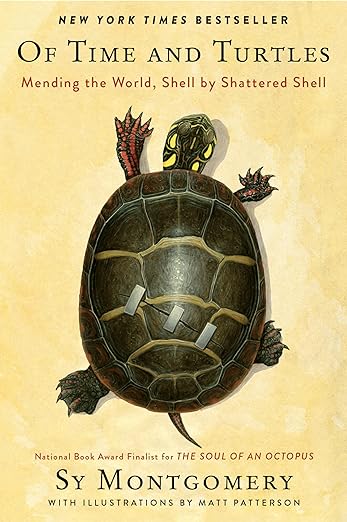
This book brings back memories. My Dad had a pet guinea pig he named Toodie. I don’t know where that name came from as Dad didn’t talk much about all the stuff he was thinking about. Toodie lived freely in our house, leaving compact little turd pellets anywhere it pleased. And would come running every morning when Dad came down the stairs whistling its name.

Dad also had a budgie bird that he named Foxy. Again, sure wish I knew how he decided that name. Foxy flew around without restraint. It would sit on his shoulder and gently pick at Dad’s eyebrows and tap away on his glasses. And seemed to love sending little guinea pig Toodie running for shelter under the sofa.

I’m trying to recall if our family ever had a pet turtle. In the United States, baby turtles -just the right size to fit in a child’s mouth- have been illegal to sell since 1975 due to fear of salmonella bacteria. Laws in Canada have been mixed regarding their sale and possession. We probably did have a turtle since they were available in every aquarium/fish store at that time. I have no recollection of putting one in my mouth.

Looking at just the cover, one might think it to be a whimsical book with a few ‘morality’ lessons. It is everything but that. Sy Montgomery is a global naturalist and “internationally bestselling writer of thirty-six celebrated books for adults and children.” Her insightful analysis and narrative ability have converted the realities “of time and turtles” into a fascinating metaphor to enhance our awareness on several fronts.

On one level, this book uses the plight of turtles to focus on ecological and environmental issues. Montgomery traces the daily missional work of men and women who are devoted to rescuing and restoring turtles from the ravages of the world, primarily the highways around which they live. With a 50% reduction of commuter traffic during the COVID pandemic, one study showed that “the numbers of animals, from cougars to turtles, saved by the reduced traffic will be estimated in the tens of millions.” This COVID connection reminds me of the satellite pictures taken over China that showed, for a brief duration of time during the pandemic, it was possible to see the ground undisturbed by air pollution.

Since I am in Canada, I must include the author’s Banff illustration. She describes how Banff (“in Canada”) has created safe corridors for wildlife to cross highways. There are 6 overpasses, 38 underpasses, and extensive fencing to guide wildlife away from the roads. The net effect? It is “estimated to have saved more than 200,000 individual animals, from lynx to toads, since completion in 2017.” That’s pretty good, eh!

For the men and women in Montgomery’s story, “caring for turtles is more than a job, more than a charity: It’s a sacred devotion.” The reality narratives of daily ‘in the trenches’ work done by these heroes are worth reading on their own. But the author also uses the turtle to raise a more conceptual and philosophical issue – the idea and experience of time.

A predominant feature of turtles is their longevity. One fascinating fact from Montgomery: “A turtle who recently died at age 288 was alive when George Washington was born, when homes were lit by candles, medicine largely consisted of enemas and bloodletting, and mental illness was treated with powder made from the hooves of moose.” Wow! I had to read that twice.

Montgomery says, “Everything takes a long time for a turtle.” They live and breathe slowly. Their hearts beat slowly and they even die slowly. Examples abound in the book of these extraordinary qualities. It may take several days for a turtle to gradually respond to an anesthetic or antibiotic treatment. They are not assumed dead until decomposition sets in since it is common for a turtle to appear dead for quite a while then gradually stir again. As Natasha, one of the key rescuers in the narratives, says, “Time is what the turtles have.”

Time. A concept that philosophers, astronomers, and many others have wrestled with for a long time (I hope you get my attempt at provoking a smile). The arrow concept of time was proposed in 1927 by physicist Arthur Eddington. Like an arrow’s flight, time goes in only one direction. In comparison to space, which moves forwards and backwards, time always moves forward, never in reverse. I can’t help but think of all the novels and movies that aim to ‘challenge’ this reality with tales of elaborate contraptions and excursions into the past or future.

Just to muddy the waters a bit more, the author adds Albert Einstein to the discussion. His concept of time was not an arrow pointed in only one direction. When one of his close friends died, Einstein wrote to the grieving widow, “Though he has left this strange world a little before me, this means nothing. For us who believe in physics know the distinction between past, present, and future is nothing more than a persistent stubborn illusion.” For Einstein, his friend was still on the landscape of life but just over the next hill where we cannot presently see him.

With this deep awareness of the magnitude and mystery of time, Montgomery links the concept of time to her focus on turtles. She affirms that people throughout history have tried to explain how time began and used the turtle as a vehicle of explanation. Hindu and Buddhist mythology have the tortoise Akupara who carries the world on her back. China has the World Turtle named Ao whose legs prop up the heavens. Indigenous peoples refer to North America as Turtle Island. And, interestingly, this is the continent with the most turtle species in the world.

Linking time and turtles to philosophical and religious paradigms, Montgomery challenges us, even in the midst of global calamities like the COVID pandemic, to take ‘the long view’ of turtle wisdom. Maybe time is not linear at all. Rather than being an arrow, perhaps time is an egg. She suggests that we make it “a turtle egg – with its promise that each end might lead to a new beginning.”

Oh What a Beautiful Morning

Posted on April 29, 2024February 14, 2026 by admin

Today was so special. I had one of my regular coffee hours with a close friend at our favourite A and W. We are both glad they still receive old coupons for some time after expiry. I made another stop on 8th Street then pulled into Sobey’s to pick up a few things. Not realizing that, at the checkout, I would have an inspiring conversation that reminds me how every day can have a beautiful morning.

At the checkout, I met Hina (pronounced Hee-na). She was born in Pakistan, grew up in Saudi Arabia, and migrated to Canada. Hina was so friendly and open to conversation that I felt free to ask her a few more questions. She shared how oppressive life was for women in both of those countries. And how thankful she was to be in Canada where she has a freedom she never had there.

With a growing sense of mutual comfort, I asked if Hina grew up in the Islamic faith. She confirmed that she did then spontaneously went on to tell me about a book she read by an American pastor. When she said, ‘The Purpose-Driven Life,’ I had a bit of a shock. This was a book written by Rick Warren, the evangelical pastor of Saddleback Community Church in California. A book that deals with generic human and life issues but is clearly based in an evangelical Christian perspective. With no one waiting in line at the moment, Hina was quite animated in sharing how valuable that book was for her. And how she could see so many compatible beliefs between Islam and Christianity.

Wow! This was something I was not expecting. A vibrant Islamic woman instructing me about the valuable material in Warren’s book. I told her I was a Christian but, for some reason, felt compelled to add that the extreme right-wing evangelicals in the United States did not represent my Christianity. With a broad smile, Hina shared a few more comments on the healthy, wholesome beliefs and values that should define our respective faiths. And, again, how compatible she thought those core values are.

I was so grateful for our brief but powerful conversation. And even more thankful as I write these words. It was a moment of connection between two people who came from different worlds, still functioned out of different religious systems, but mutually had a sense of the elements of faith that must be the foundation for whatever structure we build to make sense of life and living.

Someone was now coming to the checkout counter. I picked up my two bags and, without thinking, said, “Bless you.” With a smile, Hina said something in return that I couldn’t hear. But I kind of think that she was blessing me as well.

I Surprised Myself

Posted on April 28, 2024February 14, 2026 by admin

This morning I took a risk. I surprised myself. And I’m glad I did.

For this narrative I must give you a bit of backstory. All my life I have not shared any food. No arms entwined with my loved one to feed a forkful of meat or vegetables from each other’s plate. No taste of a drink or sip of a milk shake. No giving my child a lick of my ice cream cone. Even if it is my favourite flavour. You want a lick, you can have the whole cone. I think you get the picture. So now my story from this morning.

I have gone to the 8 a.m. Sunday service at St. John’s Anglican Cathedral several times. Usually there were 20+ people in attendance at this early service. Today I was one of 5 plus the priest and the on-duty deacon. All times previous, I have slipped out quietly (other than when I tripped on the step going down to the exit door) and avoided participating in the Communion service. It was an escape motivated by fear. Even medical pamphlets on display during the intense COVID years weren’t enough to keep me there.

What was I afraid of? The act of sharing the wine from a common cup (actually a finely-crafted goblet). The individual wafers were fine. Straight from the hand of the priest onto the palm of the penitent’s hand. Not at all threatening like each person plunging their hand into a large loaf of bread and ripping out a chunk. But the common cup was too much. I read the pamphlet with research data intended to encourage me to participate. It affirmed that my fear of bacterial, viral, or any other contaminant was not based in fact. I had more danger of getting sick from sliding my hand along the pew railing and sticking my finger in my mouth.

So, today, why didn’t I get up and run? As I looked around at the other people in attendance, something happened inside. The widow limping up the aisle to place the collection plate on the altar. The bearded middle-aged man, in dress suit, fulfilling his duties as the active deacon, reading the Scripture passages with clarity and conviction as if to 100s rather than just the faithful 5. The elderly couple – now that I am almost 76, by ‘elderly’ I mean in their late 80s – who were clearly sitting in their ‘reserved’ spot every week. Whose left? Another single person near the front. And yes, there was also the pianist at the piano, a newer addition to Anglican worship.

Perhaps the ‘icing on the cake’ to entice me to stay rather than flee was the priest herself. She cast me a welcoming smile when I entered the sanctuary five minutes late and purposefully sat well behind everyone else. Her sermon focused on Philip and the Ethiopian eunuch who, when given insights by Philip, said, “Here is water, what prevents me from being baptized?” With more contemporary points of reference, she teased out the question, “What prevents us?” from loving God and showing love for one another. A sermon only 10 minutes in length and read from a manuscript. Yet the priest’s passion for the subject at hand, and her increasing connection visually with each of her listeners, drew me into the landscape she was painting.

By the time it was all over and the tiny group was heading to the front for Communion, I realized that I was an integral member of an organic micro-community gathered in that place at that time. We were pilgrims sharing a common journey even though none of them knew me and I knew none of them personally.

And so, as I answered the question, “What prevents me?” from participating, I realized that I wanted to and must do so. Forgetting my fear for a moment, I lined up with the other 5. The deacon was serving the wine after the priest served the wafers. Never having previously taken Communion in an Anglican church, I watched the 5 to see when they ate the wafer and didn’t quite get the timing right. But no one was assessing my performance so I was okay.

Then the deacon approached with extended cup, looking kindly into my eyes and reciting the appropriate words. I was second in line so just one set of lips were on the cup before me. Other than I think he and the priest may have taken their sip while preparing everything at the altar. He wiped the rim of the cup and shifted it a quarter-turn so my lips would touch a new spot. I looked at him, looked inside the cup, and saw that it was white wine not red. I don’t know why I expected it to be red – well, I guess I do know. As I looked at him, and he looked at me, I realized this had the makings of what I have heard is called a ‘Mexican standoff.’

A lot can go through a mind in a few moments. I relived all my fears. I reviewed my new fellowship of humanity with the 5. I revered the devotion of the priest and deacon. And within that few moments, I recanted my fear, took hold of the cup, and sipped. He moved on to number 3. I looked around at the beautiful cathedral and realized what I had done.

As I write these words, I have a fresh sense of what was a significant moment of release, of inclusion, and of expression in my life this morning. They received me without question. And I was finally able to come alongside them without reservation. I am blessed. And a better person for it. At least until I am hit with another fear or bias in a new incident of life.

The Ironies of Life

Posted on April 24, 2024January 26, 2026 by admin

Irony of Life: When we want/need something the most, many of us can afford it the least; and when we can afford it the most, we no longer want or need it.

When people ask where I grew up, I often say, “I farmed until I was 2.” That line usually gets a smile. I was about 2 when my family left the farm for a Northern town where my father and uncle bought a grocery store. It was a mining town in the middle of nowhere. And there was an abundance of excellent fishing lakes all around us. Probably my best memory of father-son outings while growing up was time spent on a lake.

After retirement, my father (Nick) still made regular trips to that town to enjoy the opportunity for good fishing. He would usually team up with his nephew Ed who also was retired. No more jobs. Children all grown up and gone. Just the two of them heading out to enjoy the lake and bring home some fish, preferably pickerel, for supper. (As traditional Ukrainians, they had no concept of the evening meal being called ‘dinner’).

I can visualize Nick and Ed floating peacefully on a favourite fishing spot and jigging for pickerel. Jigging. That’s where you shut off the engine, throw out the anchor, drop your hook into the water, jerk your line up a little bit every half-minute or so, and let it settle down again. All of this is done with the hope of attracting a fish. Those who are serious about fishing will have their own version of what is the best bait to put on the hook. It could be a piece of meat, a kernel of corn, or some other often secret ingredient that would likely not be shared with others for fear that they might catch your fish.

Usually, what is said on a fishing boat stays on the boat (something like going to Las Vegas). But Dad shared one conversation with me that has stuck in my memory. He and Ed were on a favourite lake in Ed’s boat. Enjoying the comfort of a glimmering sun, a warming breeze, and a gently rocking boat, Ed broke the silence and began to share his thoughts in the moment.

I don’t have a transcript of those words but will reconstruct what Dad passed on to me.

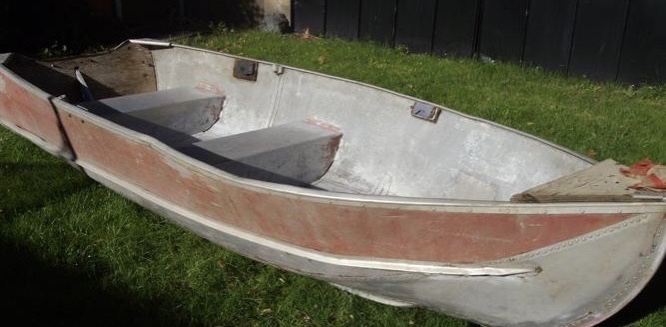
Always a soft spoken man, Ed wistfully said, “Nick, life doesn’t make sense. When my kids were young, all I had was a 12-foot aluminum boat, a 5-horsepower motor, and the cheapest fishing gear. And all too often, I was ‘too busy’ when my kids asked if we could go fishing.

Now, they’re all gone. I’m retired and have all the time in the world. And here we are in a 20-foot fiberglass cruiser, a powerful engine, and all the best equipment you can buy.”

My Dad was usually a man of few words. He looked at Ed, smiled, and nodded his head in agreement.

Two men alone in a beautiful new boat. Sharing the poignant reality of one of the ironies of life. When we want or need something the most, many of us can afford it the least; and when we can afford it the most, we no longer want or need it.

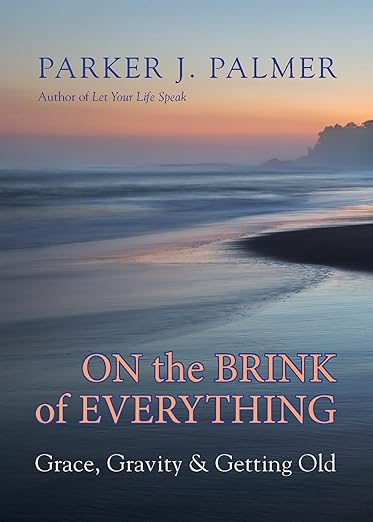
On the Brink of Everything

Posted on April 24, 2024January 26, 2026 by admin

*Grace, Gravity and Getting Old*

How do you decide when you have something, or something more, to say?

After publishing his 9th book at age 72, Parker Palmer thought he was done. Then, years later, his editor asked if he was working on anything new. He said ‘no’ but the editor wasn’t convinced. For Parker had been writing some brief essays and a bit of poetry. She asked him is he realized what all of that was about and he replied that he just writes his stuff not reads it. So she informed him that pretty much all of it was about “getting old.” The end result was this new book published at the age of 79.

I like Palmer’s 3 G’s in the sub-title. We spend a lifetime trying to figure out what Grace is and where to find it. Gravity finds us as body parts begin to sink towards the ground and feet must try harder to move forward. And Getting Old just happens. Yet Palmer, on the cusp of 80, still affirms that we are “On the BRINK of EVERYTHING.” He insists that we must “reframe aging as a passage of discovery and engagement, not decline and inaction.” And then he proceeds to offer his experience and encouragement through a collection of 24 brief essays and a variety of poems.

At 76, I still don’t think in terms of ‘getting old’ – although the reality of gravity and the need for grace are certainly alive and well. As a slow learner, I just retired from ‘carrying my lunch pail’ a year ago. I didn’t have a master plan. I just kept showing up for work. And, even after I went from employee status to one-year contracts (at my request) at age 65, no one ever came to me and said, “Your services are no longer required.” So, after 10 more years, I decided it was time to join other retirees in having all day to fight gravity, seek grace, and talk about getting old. Here I am, just finishing the first year and it is like I am starting to live all over again. Having to figure out a whole new agenda. On the brink of everything.

Don’t hear me wrong. I miss my work community of colleagues. And the last 5 years, where I had no administrative responsibilities, were the most satisfying of my 40 years in college and seminary work. I could focus entirely on my teaching areas and relationship to my students. But now, that’s gone. And its departure has made room for all that lies over ‘the brink’ of upcoming years.

What kinds of things does Palmer want to keep in mind as he moves into his 80s and beyond? And is any of this relevant for you at this point in time? If you are 50, that is a whole generation younger. If you are 20, that is two generations. I find it difficult to conceive how I can be 60 years older than my oldest granddaughter and 70 years older than my twin granddaughters. No wonder I am so unsure about how to be effective in relating to them.

If you’re still reading, I guess you want to hear a bit more about what Palmer sees over ‘the brink’ of his coming years. He focuses on several themes:

Young and Old: The Dance of the Generations – to seek creative engagement with the young.

Palmer says, “When young and old connect, it’s like joining the poles of a battery. Together, we generate energy for personal and social change that an age-segregated society cuts off.” Mentoring becomes a two-way street flowing both ways between young and older. Parker calls it music and a dance. If we can “knock down the walls that keep us apart and meet in that in-between space,” the end result will be that all of us are smarter.

Getting Real: From Illusion to Reality – to gain more insight into ‘the mystery’ of life.

Palmer says, “The spiritual journey is an endless process of engaging life as it is, stripping away all our illusions. . . and moving closer to reality as we do.” He implies that true spirituality is not the illusion of floating above the realities of life (i.e., being so heavenly minded that we are no earthly good) but rather being immersed in real living. Being engaged. The vehicle for this process may be different for each person and may evolve through one’s life. Palmer himself grew up in the Methodist Church, migrated to the philosophy of the Trappist monk Thomas Merton, and landed in his zone of comfort as a Quaker.

Work and Vocation: Writing a Life – to clarify the difference between the jobs by which we make a living and the callings, or sense of vocation, that give meaning and purpose to all that we do.

Here Palmer asks us to tune in to what has given, and hopefully still gives, us joy and internal satisfaction. It may have been connected to our work life but could also be outside of it. This is the unction that we can take with us over the brink when the job is left behind. The creative force that will continue to make meaning during the next phase of life. For Palmer, that passion was writing.

Keep Reaching Out: Staying Engaged with the World – to maintain a live connection to the world around us.

Palmer’s words say it best – “When I’m with elders whose world has shrunk to the dimensions of their TV room, and have no health problems to limit their mobility, it’s as if I’m with the walking dead. But when I’m with elders who have a mind-and-heart connection with the world beyond their walls, I find their vitality contagious, even if they are confined to their homes.” As an indication of his old-age bravado, Palmer takes off the gloves and shares his political convictions. But I’ll leave that part to your own reading of the book.

Keep Reaching In: Staying Engaged with Your Soul – to ‘know thyself,’ to embrace Socrates’ declaration that ‘the unexamined life is not worth living.’

Palmer affirms the necessity of growing our personal inner life irrespective of, and even unrelated to, any religious tradition. He says it is a “silent, solitary process of reflection. . . where we put our lives in perspective, embrace our shadow and our light, transcend the regrets and fears that often come with age, and reconcile ourselves to what the poet Stanley Kunitz calls the heart’s ‘feast of losses’.”

I don’t know how I would respond to this book if I was 45. Probably would let a lot of the content slip by me and encourage it to move on to someone else. Someone like myself now reading it for the second time at age 75. It is more pressing now than ever that I take seriously Palmer’s injunction, “Knowing yourself and sinking your roots into the ground of your being are critical in old age.”

He declares that I must embrace the whole of who I am, all the affirming and incriminating qualities. For Palmer that includes the conflicting qualities of “self-serving and generous, spiteful and compassionate, cowardly and courageous, treacherous and trustworthy.” He sees himself and, by extension, me, as a masterpiece of conflicting tendencies housed in a being that is nearer the end of life’s trajectory than its beginning. And he encourages me to face all of it with honesty and humility. Doing so, I have a chance to truly be “on the brink of everything.”

Growing Into a Leader

Posted on April 13, 2024January 26, 2026 by admin

Let me introduce Josh whom I have known since his graduation from high school. I don’t have a picture. He would be embarrassed to be the centre of attention. So I will share my reflection and preserve his anonymity.

After trying a few post-high school jobs, Josh settled into what has become a longer-term career in consumer sales. He never expressed any leadership aspirations. Yet, as I have observed him on the job over a number of years, Josh has developed into not only a good employee but also a growing leader.

Seeing him a few days ago is what motivated this reflection. A new employee was having difficulty processing some details surrounding a customer’s purchase. I watched Josh enter the scene with a smile, gentle words, clear directions, and a minimal amount of hands-on example to illustrate what needed to be done. His entire presence was a nurturing context. I was proud of him.

I also watched the new employee. A fine-looking young man, nicely groomed short beard, contemporary glasses and hairstyle. Probably a university student on his way to a professional career in a few years. If there was any tendency for him to resist ‘being told’ what to do, or any feeling about the possibility of ‘looking stupid,’ he didn’t go there. He didn’t need to. Josh came in with a precursor of respect and patience. The newbie listened closely, asked a few questions, and settled in to finish the transaction. No damage to his hubris. Just another positive brick in the building of his own competence and confidence. And, hopefully, his own ability to nurture rather than demean those who would be under his purview in the coming years.

As I was leaving the building, I had another look at Josh – standing at an employee station in the midst of customers who were coming and going in all directions. There he was, upright in posture, an inviting expression on his face, fielding questions from customers left, right, and centre. People approached him without hesitation as if one look told them it was okay to do so. I was proud of him.

I couldn’t leave without speaking to Josh. I shared my observations from the informal ‘training’ session with the new employee. I commented on how he looked as he responded to questions at the employee station. Josh kind of hung his head sideways, smiled a bit, and ‘sluffed it off’ as nothing for me to get too excited over. He said a few things about how there are many levels of detail in that business. And how it takes time to develop the ability to respond to more situations more effectively in less time.

As I grasped his hand and squeezed his shoulder, I told him how proud I am of him and what he has become as a young man (also married for several years and he and his spouse longing to have a family). And I turned away before he could see the moisture welling up in my eyes.

For Josh has spent years thinking that he ‘fell’ into his present job and ran out of time and options for anything else. I so desperately wanted him to know how important he is to his organization, to his fellow employees, and to customers (like me). How sacred all work is. How it is possible to find a sense of personal vocation in any occupation.

With gratitude, I affirm the many Josh’s (and Jane’s) who show up each day, faithful to their current placement in life, and bring sunshine rather than shadow to the lives of everyone they touch.

Grocery Shopping is More Difficult Now

Posted on April 13, 2024January 26, 2026 by admin

Wow! I am hungry for everything I see – especially in the Bakery section. Recently my spouse and I decided to alter some of our food and eating habits. I found it quite easy to do that while stretched out in my recliner and just talking about it. Kind of a challenge when actually pushing the cart up and down the aisles. I enjoy doing most of the grocery shopping for our house (actually, we live in a condo). It is a personal social outing with myself by myself. Very seldom in a hurry. Usually go to the same two stores (one green, the other yellow) so I don’t get lost in the midst of everything.

Some time ago, after the ‘green’ store rearranged their Produce section without consulting me, I found myself in unknown territory. Panic began to set in. I realized I was in the Organic aisle. What to do? I feared being pounced upon by some of the products and force-fed into a vegetarian state of mind. So I got out of there quickly. Since that time, with my new awareness and intentions, I smile and wave as I go by that aisle. No fear. Just a growing healthy respect. I haven’t crossed the river to that side (yet, and maybe never will) but have found a new, non-judgmental wellbeing in considering them my colleagues rather than adversaries.

The other vegetables and fruit surround the Organic aisle to protect it from potential harm by callous unbelievers. And, with our new increased attention to plant-based foods, I spend a fair bit of time there. Oh, the asparagus is 2.99 when usually 6.99. Great. That will do us for servings at two suppers (I still have a hard time saying ‘dinner’ for the evening meal. Until recently, I thought you had to be smug Democrat from New York City to call it that). Ah, a smaller package of Mixed Spring Greens. That’s good. Barbara has suggested she would like a change of taste from the spinach which I bought in an unduly large volume a few weeks ago.

I need to draw strength from Produce because next stop is Bakery. Or, I should say, it used to be a full stop. I would examine birth dates for croissants and danish then do math for whether the large or small ones were a better buy. And the various donuts (chocolate, sprinkles, coconut, cream) beckoned to me from behind the glass door. The siren call has weakened a bit since new standards have now imprisoned each one in its own cellophane wrapping. I feel their pain since much of the aromatic and visual attraction has been shrouded by reflective plastic.

Yesterday was a particularly difficult time in Bakery. We have shifted to less use of bread. But a few weeks ago, when we were going to have a new soup for a few meals, I ‘caved’ and bought a beautiful round loaf of San Francisco sourdough. Right now I am reliving the joy of each slice. And there it was in front of me yesterday. That rotund loaf with artistic indents and sprinkled with just a dusting of flour on top. With white and black angel on each shoulder pressing in on my conflicted state of being, I finally broke through, turned my back in wilful disdain, and got my cart out of there. Maybe next time – when we have new soup for a few meals.

By the time I got to freshly barbecued chickens on their heated racks, I pretty much ‘had it together’ again. Just a whiff of that enticing aroma then I turned left into the Wellness section. Yes, that is what it’s called. And it is huge. Until recently it was foreign territory to me. But now I devote time to examine all the options for non-dairy milk. I have taken a liking to Unsweetened Oat but with Vanilla flavour. Almond also works. I am just a beginner but there are numerous other options for advanced learners.

At this point you may be thinking that I am now a vegan or, at minimum, a vegetarian. I would say neither but rather a Visitor to these realms of philosophy and lifestyle. Our present decision is to do more of plant-based whole food. We still love barbecued skewers of chicken and various vegetables. Fish and seafood are a regular pleasure. And, to officially welcome Spring when I open up my deck, I do plan to lovingly barbecue a good steak, sauté some mushrooms, and add some type of compatible potato.

I began by saying how difficult grocery shopping is now. That was a bit of hype to get your attention. The truth is, each time I leave the store having made good decisions (‘good’ in view of our current priorities), I feel more empowered to continue down this new road of discovery.

My Name is Robert

Posted on April 8, 2024January 26, 2026 by admin

His mother may have called him ‘Robbie.’ To his childhood friends he was ‘Bob.’ But now, “My name is Robert.”

I met Robert at a Waffle House restaurant on the road from Niagara Falls to Niagara-on-the-Lake. By the way, that is a phenomenally beautiful drive along the river, surrounded by vineyards and historic mansion properties. Memories are flooding in but – back to Robert.

We stopped at the Waffle House for a late breakfast after checking out of the hotel at Niagara Falls. The interior of the restaurant was 1960s in crisis. One table had two people in quite an agitated state and, as we sat down, they got up and left. Mumbling something as they passed by us, it became apparent they got tired of waiting for service.

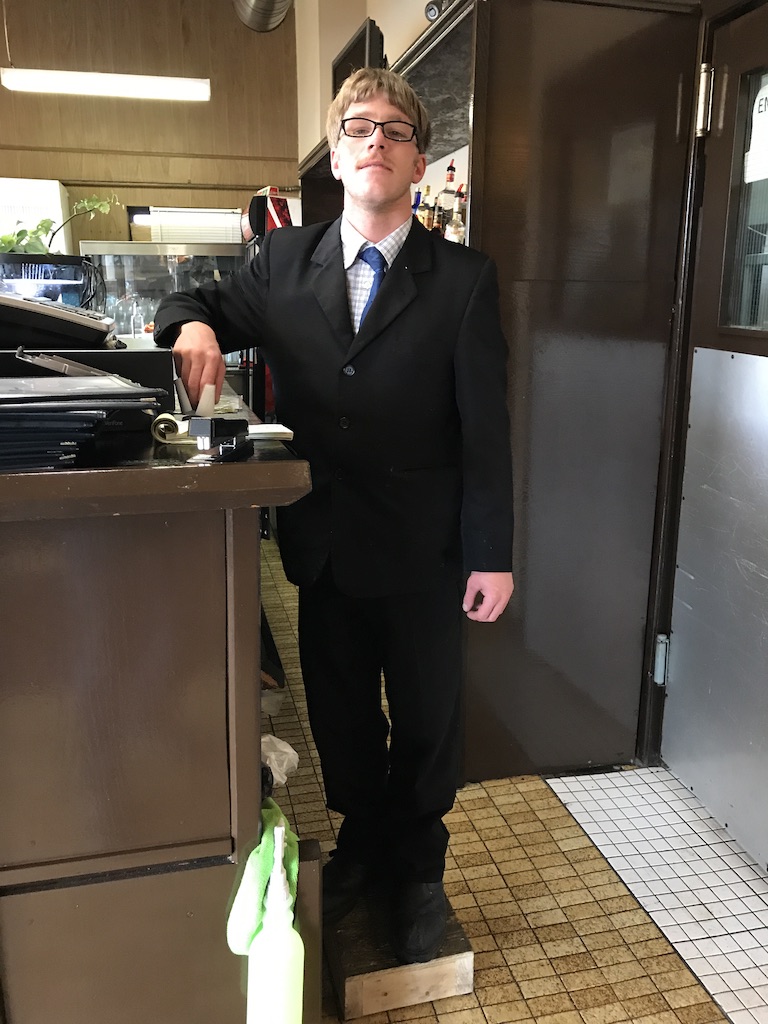
We looked around the empty room, saw a guitar leaning in one corner – that’s interesting – and were about to make a break for it ourselves. Then Robert – whose name I learned later – came out of the kitchen, dusting himself off from flour, crumbs, and other indeterminate matter. Not being able to ask Robert for permission to share his picture, I will assume that his princely manners would not be offended by you seeing him here.

Robert was a model of restauranteur decorum as he shook out his pant legs, straightened his disheveled suit jacket, tucked up his tie, squared his jaw and, with head held high and pen with pad positioned precisely before him, asked us what we would like to order. We were now ‘down for the count’ with no real option to leave. So, with a sigh of foreboding uncertainty, we submitted our requests. Robert disappeared into the bowels of the restaurant and we sat.

Did I mention that we sat. Yes, a rather long period of time passed during which we heard the clatter of pots and miscellaneous activities from the kitchen but no sign of Robert. As we were on the verge of revisiting the option of personal removal, Robert flowed into the dining room with our food. I would like to say that it was a delectable sight. But it wasn’t. Visualize teaming with your 5-year-old child to put together bacon, eggs, hash browns and toast, and you will have a pretty good sense of what the tray of food looked like. Yet Robert administered his craft to us – yes, he had done the cooking – with the flourish of one trained in the finest culinary arts of France.

At this point we were captives to a food experience that would be memorable if not delightful. While we tentatively bit into our meal, Robert stood at attention over us (you do remember that there was no one else in the restaurant) and offered to play his guitar for us as we ate. As I reflect on that day, I still ask myself why we did not accept his offer. That would have been a climactic finale to a surreal event.

We did our best to honour the sacrifice of the elements that went into our meal then moved to pay the bill. At that point Robert pulled out his little stool, as he was under five feet tall, and literally stepped up to the cash machine. After we paid, he graciously thanked us and excused himself because he had to remove and wash the dishes. Yes, Robert was restaurant host, server, cook, dishwasher and, if requested, resident entertainer.

Before he left, I asked him his name. “My name is Robert.” I asked if I could take his picture. He prepared himself upon his stool and there you see him. I have some emotion rising as I write these words. Here was someone whom society-at-large could easily marginalize. And probably whom the restaurant ownership was grossly taking advantage of. Yet I have not seen a better example of personal pride in tangible purpose. I am so glad we stayed and not only met Robert, but had the privilege of our lives being enriched by everything holy that he embodied and lived out in daily practice.

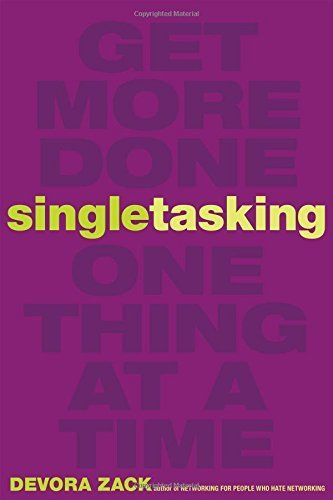
Singletasking

Posted on April 5, 2024April 11, 2024 by admin

*Get More Done – One Thing at a Time*

I would like to say this book changed my life. But I can’t. Old attitudes and behaviors are hard to shift even in the face of new evidence. I don’t know about you, but I often assumed the persona of being able to multitask at a high level.

A bit of pride is usually attached to that stance. I think I had some pretty good arguments to support my perception that I really was doing multiple things at the same time. Then along came Devora Zack.

In some ways it was a bit like the nursery song. I was Little Miss Muffet, sitting on my tuffet (computer chair), eating my curds and whey (basking in simultaneous use of Word, Excel, PowerPoint, Safari, iPad email, and cell phone social media).  Then “along came a spider (Ms. Zack) and sat down beside her (me) and scared Miss Muffet away.” The breakdown occurred at ‘scaring me away’ from my tuffet and multiple devices. It wasn’t that simple. But that is jumping to the end of the story. I’ll go back and fill in some of the gaps. And you can decide what to do when ‘along comes a spider’ to your tuffet and starts messing with your curds and whey.

So, what is this ‘singletasking’ (getting more done – one thing at a time) all about? Zack’s fundamental premise is that multitasking is a myth. Okay – that kind of hits where it hurts. To Zack, what I (and perhaps you) call multitasking, she calls task-switching, even if it is done at what appears to be the speed of light. She quotes a neuroscientist, “You cannot focus on one task while doing another. . . there will always be interference between the two tasks.” To say we can multitask is “deluding yourself.” But how can that be true? Many of us study and play music at the same time. Drive and talk to a passenger in the car. Watch tv and knit. Mop the floor and sing.

Zack’s response is that “activities that require virtually no conscious effort can be performed in conjunction with simple tasks and do not fall in the bandwidth of multitasking.” Such ‘simple’ tasks are “automated, low-level functions, including rote activities that do not require concentration.” There is no competition for the same mental resources. I’m not really listening to the music until something catchy comes on and I shift my focus from studying to what I am hearing. I am an experienced driver in a familiar car who knows this road well. I have done so many knit-one pearl-two’s that I can knit while doing jumping jacks. And, while singing like Zorba the Greek, I am hardly even aware of the floor. In fact, I am likely not aware that I am in fact dancing with the mop.

Are we getting the point? We think we are doing multiple things at one time. And perhaps we are. But only one of those things is really getting the primary focus of our attention and energy. And usually it will be the new or newer thing that hasn’t been rehearsed into being automatic yet.

A major concern for Zack in offering her thesis is that, in our overly distracted states of trying to do too many things at the same time, we lose out on the very essence of quality and value of each experience. We ‘blow’ through life like a hurricane then wonder why we are stressed out and not really enjoying enough of it. Zack calls us to immerse ourselves in the present experience, BE here right now, and do one thing at a time.

Her subtitle is “Get more done – one thing at a time.” Yet perhaps the best value of what Zack shares is that we might eventually find ourselves gradually shifting from the mania of DOING to the serenity of BEING.

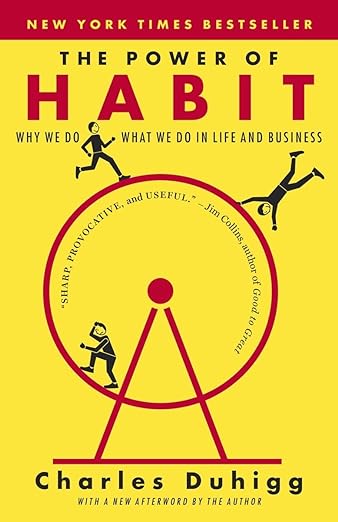
The Power of Habit

Posted on April 4, 2024April 11, 2024 by admin

*Why We Do What We Do in Life and. . .*

I typed ‘motivation’ into Amazon.ca’s little white box and it offered me over 100,000 titles. ‘Psychology of motivation’ reduced the number to over 50,000 titles. But you don’t need me to tell you how pervasive the concept of ‘motivation’ is in all fields of study and explanation of human behavior.

Somewhere along the path of life, I encountered the phrase, “There is a reason for everything.” It stuck with me. When I saw an expression of anger by a customer at a sales checkout stand, I could temper my internal response with that phrase. How could I know what was going on in that person’s life at that moment? There was a reason for a loss of emotional control.

You can think of your own examples, probably even from today. And, if you haven’t ‘left the house’ yet to encounter another human being, you likely have been an example yourself in some way. Think about it. There is a reason for everything. Keeping that phrase close at hand just might allow me (and perhaps you as well) to walk through a day with more compassion and mercy.

But there is good news! You don’t have to cycle through 50,000 or more items. People like Charles Duhigg have created models of understanding and behavioral change to help us. In The Power of Habit, Duhigg addresses three circles of habits starting with individuals, then organizations, and finally, societies. My interest here is the primary context of individuals. That means me and you.

After describing new learning from two medical case studies of men named ‘E.P.’ and ‘H.M.,’ Duhigg outlines what he calls ‘the habit loop.’ It’s a pretty straightforward process in our brain that unfolds in three steps:

  • Cue – is a trigger “that tells your brain to go into automatic mode and which habit to use.”
  • Routine – is the physical, mental or emotional sequence we go through in response to the cue.
  • Reward – is the end result; the strength of our interest in the reward will influence the brain’s level of assessment as to whether this particular loop is worth remembering for next time. 

The marketing of consumer products is totally invested in cultivating these habit loops. Duhigg describes how Pepsodent toothpaste ‘rocked its world’ in the early 1900’s. Dental care was so non-existent that “when the government started drafting men for World War I, so many recruits had rotting teeth that officials said poor dental hygiene was a national security risk.” However, by 1930, the crafting of a crafty habit loop created the daily brushing ritual for most of the American people. How did they do that?

The cue was marketed as “Run your tongue across your teeth. . . you’ll feel a film. . . that’s what makes your teeth look ‘off color’ and invites decay.” The reward, after the simple routine of a quick brush with Pepsodent, was a prettier smile. And so, the use of toothpaste in America went from 7% to 65% of the population.

Claude Hopkins, the instigator of the Pepsodent tsunami, became rich and pontificated two basic rules of human psychology: First, find a simple and obvious cue (e.g., tooth film); and second, clearly define the rewards (e.g., beautiful teeth). Hopkins’ rules, even today, “are a staple of marketing textbooks and the foundation of millions of ad campaigns.”

If you find this drama interesting, check out the equally fascinating story of how Procter and Gamble moved Febreze from the dustbin of obscurity to the front shelf in the laundry room of every home in America.

So what good is all of this to you and to me? Well, our interest – at least my interest – is “How can I create new habits?” How can I change patterns of my behavior to move in new directions? How can I get rid of behavior patterns that are no longer (or never were) desirable? Duhigg has more good news.

With the assistance of rats and monkeys, researchers have established that the sight (or sound, or any of the senses) of the cue stimulates a craving which then jumpstarts the routine towards the reward. Seeing an enticing food ad on television sends us to the fridge or Uber Eats, Skip the Dishes. . . you know what I mean. The Marlboro Man had the power to raise many a man (and woman too) from their couch to grab a smoke. The chime of a new text coming in causes many cell phones to be balanced on knees under the table during meetings. The list goes on and on.

So, what’s the good news? In its utter simplicity, it is – Revise the craving! Bring the reward to the front of the bus. Frame it as a cue that inspires our motivation. Allow it to gently nourish a new craving. So, I go to the gym (or jog, or eat more healthy food, or. . .) more regularly not for some vague future promise of goodness but for the fantastic reward of feeling so good at the end of today. To know that I spent a whole day doing better than I did yesterday gives me a euphoric sense of wellbeing.

I crave that feeling of accomplishment. To anticipate a drop of .5 pound (I don’t know how many grams that is) when I step on the scale tomorrow morning makes all the discipline and supposed sacrifice worthwhile. And what is most beautiful is that very soon it won’t feel like sacrifice at all. We will experience the joyful creation of a new normal.

This ‘Book of the Week’ narrative is getting rather long. I don’t know how long it should be. It’s my first one. There is so much more in The Power of Habit. How new routines can be inserted into old habits. Alcoholics Anonymous is a powerful model where new and more life-giving cravings use even the former cues and rewards to move a person towards success by changing the routine.

That’s a wrap. A pretty cursory overview of key elements of Duhigg’s first circle of attention – the habits of individuals. In his second and third sections, the habits of organizations and the habits of societies, he continues to provide thought-provoking examples (Aluminum Company of America, Starbucks, Target stores, the Montgomery bus boycott). But that is on you.

  • Previous
  • 1
  • 2
  • 3
  • 4
  • Next
©2026 Miles 2 Go