
My father was a self-taught musician. It made him quite popular in the 1940s farming community. Ukrainian weddings, anniversaries and other special events needed a band to liven up the community hall. There wasn’t much pay other than free drinks but the prestige was high.
Dad played the tsymbaly, the accordion and, if called upon, also picked up the violin. As I struggle to learn the piano, even with a high-level instructional program, I keep reminding myself that Dad learned all his music without a single, formal lesson.
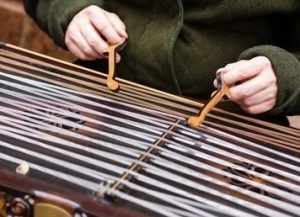
The tsymbaly (dulcimer).
To play this instrument, you literally hammer away on the strings with two wooden mallets clutched between the index and middle fingers on each hand. It almost looks like a harp laying on its side but produces a more piercing, tinny sound with multiple notes cascading on top of each other.
While a harpist elegantly, and with great sophistication, draws fingers across the strings, the tsymbalist, in attack mode from the top, beats on the strings with a vengeance. For my Dad, it was great therapy to escape from the cares of life. He would get lost in a world of pure joy.
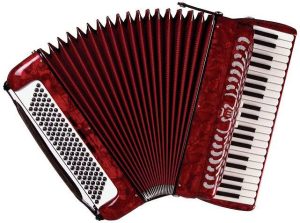
The accordion.
The heart of an accordion is a set of bellows made of flexible folds of material that expand and contract to pump air across reeds inside the instrument. Compressing the bellows to push air out creates a louder, more forceful sound while gently pulling them apart brings a softer tone as air is taken in. Surface keys control the combinations of notes produced.
Not knowing how to read music, Dad used a search-and-find method for closing in on the tune he wanted to play.
On the tsymbaly, he hammered away, back and forth across the strings, searching for what we would now call that opening chord.
On the accordion, he pressed an ear to the instrument while gently working the bellows, then punched one and another and more keys until he found what he was looking for. Then, with a few tentative riffs to secure the path, off he went and never looked back.
What was Dad looking for? The melody that was hiding in the strings of the tsymbaly or was caught somewhere in the accordion bellows between compression or expansion.
Hammers and bellows.
The tsymbaly and accordion serve as metaphors for ways in which we implement our worldviews in life, particularly when we choose to function in a more aggressive and less collaborative mode.
Our attitudes and judgments can be like hammers clutched between our fingers. We walk around and beat on things (and people) to make our point. Sometimes we hit on a positive note that makes sense. But often we just create a cacophony of noise that drives wedges between us and anyone we are trying to communicate with.
Or, we function as the bellows of an accordion. We draw in information from the world around us, make assessments, and form opinions. We then express out what is inside either forcefully with bias and judgments or gently with care and attention.
These metaphors illustrate two different lifestyles of choice:
1- Hammer away and bellow out all over the place on every hot topic of personal concern. Express final answers to all the questions and problematic issues of life. Never pause to reflect and draw fresh air that might expand personal awareness and nurture a broader perspective.
2- Gently tap on all the strings of life and living. Draw fresh air from outside of self. Open up to new learning and potential for change. Lead more often with honest questions rather than final answers. Soften the harsh stance on issues and people. Reduce the practice of judgmentalism. Realize that ultimate wisdom on all things does not reside within oneself.
Yes, I did say lifestyles of choice. To ‘act naturally’ is to choose to ‘play it by ear’ with our limited awareness and understanding. We process issues (and people) from our default temperament, personality and life experience without any curiosity, reflection, or self-analysis.
To frame it in political terms, we park our telescope (and microscope) on the right end or the left end of the spectrum and screw it into the ground. It is a choice to park in that mode and gradually calcify in our approach to life and living.
Play by ear but also choose to learn as you go.
Dad learned to play without any lessons. That approach can take us some distance. But how much more impactful to combine natural ability (e.g., playing by ear) with formal attention to new learning and skills. It expands the repertoire. Dad was good, and fun to listen to, but he did play the same things over and over again. It can get a bit stale even when you love the person.
Each of us can ‘play’ our innate human instrument without any formal lessons. Drawing on predisposed biases and attitudes, we can produce quite a disturbance. And we may even find a few chords that blend enough to create a bit of music. Yet, when we function from an untaught, unlearning posture in life, how often are we guilty of just making noise when we speak or act?
For people of the Bible, a verse may come to mind here: “If I do not have love, I am only a resounding gong or a clanging cymbal” (1 Corinthians 13.1).
Most of us want to grow in our ability to make a positive difference in the world and with the people around us. If so, let’s minimize our time with the tsymbaly hammers. There’s really no way to play gently. Rather, let’s develop our ability to work the bellows, the rhythm of life, with fresh inputs and healthy outputs.
The power of the pause.
Back to the accordion. When the bellows has been compressed forcefully and all air is expended, there is a moment of pause. No music. No sound. Just silence as the player decides to expand the bellows again and draw in fresh air.
Back to the person. During that pause in our daily interactions, a decision is made. Will the new air be fresh from outside of self? Ideas, views, attitudes learned from elsewhere? Or will it be just another intake of old air? More material to feed the internal reservoir of personal biases and stale, unchallenged final answers to the questions and issues of life.
Play it again, Dad.
When Dad played the tsymbaly, there was an intensity to his body language. The concentration brought sweat to his brow. Hammering away is hard work. It is said that a zealot is someone who has lost sight of the goal but presses on with double the effort. It is very tiring to be mad all the time (even if, in your view, it is ‘righteous indignation’).
Yet on the accordion, Dad was relaxed with closed eyes and a dream-like expression on his face. Though limited in his repertoire, he worked the rhythmic movements of the bellows to produce an integrated sound.
And the people danced.