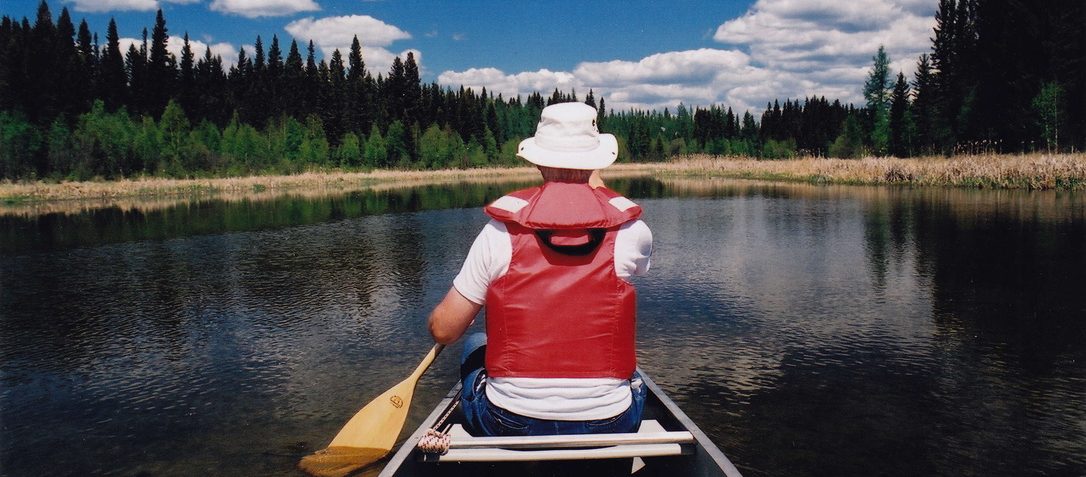
. . . and he is us.
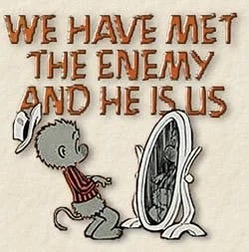
Cartoonist Walt Kelly coined the phrase, “We have met the enemy and he is us,” as a slogan for the first Earth Day on April 22, 1970. Aside from being gender-unfriendly, it became a powerful statement attached to anti-pollution posters and has endured as an iconic motto for environmental responsibility.
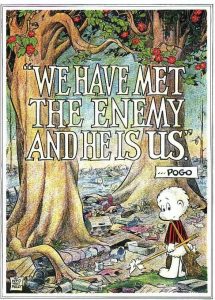
Pogo the Possum cartoon strip was created by Walt Kelly in the 1940s. It gradually became a forum for social and political satire, something that is an ‘endangered species’ in society today.
Satire is meant to tease our thinking and challenge our biases and stereotypes. Kelly took the original version of the phrase and intentionally did a twist to ‘stick it to us’ on irresponsible behaviour concerning the planet.
A twist from the past.
Pogo’s statement is a twist on words by a U.S. commander during the War of 1812. After defeating the British fleet on Lake Erie, he wrote, “We have met the enemy and they are ours.”
An interesting reversal of direction. The commander declared that the enemy was conquered and they are ‘ours’ (i.e., our captives). Whereas the Pogo statement says that WE are the enemy and we are far away from being conquered (as far as environmental responsibility is concerned).
Another twist.
I first heard the phrase as “We looked for the enemy and IT WAS us” (italics mine). The statement was a favourite expression by the conservative leader of a Christian college. He would apply it to chastise young men and women for seeking romantic attachments too early in life. In his view, we were looking for trouble and should wait until some undetermined time in the future. We were ‘the enemy’ simply because we were were acting normal with natural human attractions.
Through all the years of my association with this stalwart man of great character, I never did hear him express any personal convictions on the need for better Christian stewardship of the planet itself. His primary focus was to guide (and regulate) behavioural life choices of the young people under his charge.
In that respect, many people with a conservative Christian mindset didn’t have to ‘look’ for the enemy. We had already ‘met’ an enemy of creation care and, yes, it was us. It was too easy to park on Genesis 1.28 (to rule over and subdue the earth) rather than Genesis 2.15 (to work with the earth and take care of it).
However, be careful not to lean back with a smug attitude against religious people. Look around. You don’t have to be religious to abuse the planet.
It’s an even bigger issue.
It seems backward to get agitated about the planet or other external concerns when we daily express a wide assortment of internal contradictions, inconsistencies, biases, stereotypes, etc.
We tend to look for enemies ‘out there’ (around us) while not attending to what’s going on ‘in here’ (inside us). Every religious holy book likely has something to say about that. Those who look to the Bible need go no further than James 4.1: “What causes fights and quarrels among you? Don’t they come from your desires that battle within you?”
Our natural human tendencies towards selfishness are an ongoing challenge. If we were better at being genuine neighbours, more aware of others rather than just self, a lot of creation care would happen spontaneously.
More children’s clothes and toys passed on to others rather than being trashed. More rideshare arrangements. More of the old-fashioned barter system of exchanging personal expertise rather than buying more tools to gather dust on garage shelves. But that would require getting to know our neighbours.
The recycling dilemma.
Many small towns have the remnants of noble intentions concerning recycling. With seed money from motivated sources, an elaborate system, usually requiring significant volunteerism, was set up for collecting plastic, bottles, etc.
Within a short span of time, however, many of these worthy initiatives fizzled out due to financial, logistical and other difficulties. And small processing shacks at the edge of many towns now sit forlorn and empty that were intended to be an agent for shifting the public mindset on environmental responsibility.
Large centres have the clout to take the whole thing to another level. Some municipalities in the United Kingdom have implemented up to five distinct curbside bins: Blue, yellow, green, brown, and purple or red. [You can look up the distinctions for yourself].
These were for EACH household. And how many of them are nearly empty when the high-cost system of collection rolls down the street? I’d like to go to Britain just to see a purple or red bin.
In Canada, the 3-bin philosophy seems to be most prevalent in larger cities: Blue, green and black (or gray). Smaller centres more commonly use two bins with a tendency to move towards the third bin as governing organizations expand their realm of influence.
Cynicism lurks at the door.
It doesn’t take much insight (I resisted saying intelligence) to trash-talk the 3, 4 and 5-bin trash collection practice. Especially for those of us who are almost immune to any significant change in our wasteful habits. Expensive colour brochures, town hall meetings, video seminars. Many efforts, at significant expense, are made to get the message across.
There are so many easy targets to be trash-talked by hardened cynics who resist meaningful change in personal habits.
Is it worth it? Will people change? Can they?
If you are looking at ‘return on the dollar,’ it may not be worth it. At least in the short-term future. But if your goal is to educate younger generations towards an environmental mind shift in their daily lifestyles, yes, it is definitely worth it.
Start with the young.
Our children were instrumental in my gradual process of environmental education. They attended an Open School where parents were vitally involved in daily classes and projects. You could always tell who was on their way to an Open School meeting. They had ceramic coffee cups hanging from their belts. Ever since those early years, I still cringe every time I see a styrofoam cup.
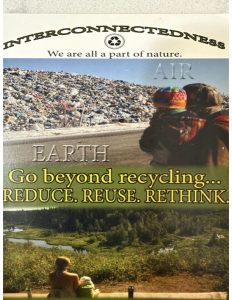
If the multi-bin puzzle is wrapping your mind in knots, why not just start with the kitchen tap. Our granddaughter learned from a young age to preserve water. At our house, she would rush to the kitchen sink if we left the tap running a moment longer than necessary. It was already ingrained in her mindset to be environmentally responsible.
Here she is at the age of four with her mother in what, to me, is an iconic picture of stark contrast.
We do have a choice. We can be the enemy of our dear planet Earth. Or we can become a friend.
Even if it is a slow process for us slow learners.