A review of ‘differentiation’ and ‘integration.’
In A ‘problem’ with “Ask Jesus into your heart,” I introduced ‘differentiation’ and ‘integration’ to describe how individuals and organizations work to create their identify. They outline differences to distinguish themselves from others (differentiation) or similarities to show avenues of potential alignment (integration).
I shared how Indigenous students in a conservative evangelical college exemplified these two approaches to the question of how Indigenous and Christian beliefs and practices should relate to each other.
Integration is less rigid than differentiation (has fewer ‘final answers’) and casts a wider net for information before making decisions. While differentiation is bound by rules and preconceived notions, integration looks for patterns of meaning from a diversity of inputs.
It isn’t an either-or, black or white, dualistic mindset. A powerful example of this tension in evangelicalism has been the issue of guidance and the will of God.
Approaches to guidance and ‘the will of God.’
Older conservative evangelicals may remember Garry Friesen’s Decision Making and the Will of God: A Biblical Alternative to the Traditional View (1984). It was a welcome breath of fresh air to some Christians. Outright heresy to others.
He challenged the traditional evangelical default view of God’s method for providing guidance. It held that we must look for a precise, specific will of God, a bullseye, when making decisions (i.e., differentiation).
Friesen offered what he called the wisdom view. It was more permissive in that it encouraged exploring a range of options before making decisions (i.e, integration). It even allowed for the possibility that a young man or woman could have more than one potential life partner out there.
In other words, Friesen’s wisdom view was integrative. It assumed a processing of relationships between relevant variables before making a decision. Whereas differentiation would look for the target’s bullseye, the precise, single answer that would distinguish it from everything else.
The differentiated approach definitely attributes more credit to God for decisions. But it also risks leaving the human mind and rational analysis in the margins.
Ironically, the challenge of differentiation or integration in pursuing the will of God is quite relevant to the concurrent problem of determining the relationship between Indigenous and Christian beliefs and practices.
A personal experience of fellowship.
I introduced this experience at the end of A ‘problem’ with “Ask Jesus into your heart” (April 8, 2026). Here is that introduction:
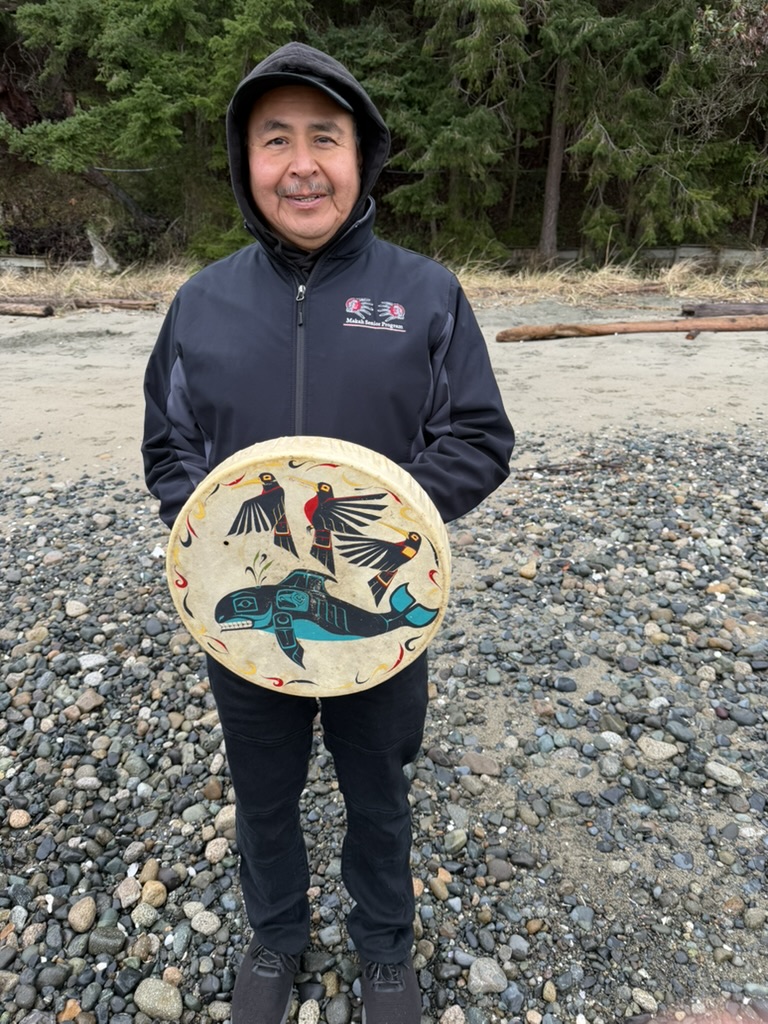
Walking on a sandy beach, I heard a light drum beat and saw a man and woman standing on the shore. As I approached them, he stopped drumming and even shifted to hold the small round drum behind his back. It seemed an act of humility to show no offence to me. Respectfully, I asked what they were doing.
Darrell and Barbara are an Indigenous couple, ‘people of the water’ from an oceanside reservation* in northern Washington state. They were having evening prayers as the incoming tide once again revealed the rhythms of Creation.
I am glad I went for that walk and felt the freedom to approach them. Our time together became an act of fellowship, prayer, and worship.
[*Note – in the U.S.A., native lands are still called ‘reservations’]
My introduction to one form of Indigenous prayers.
Darrell is 62 and Barbara 56. He works in an Indigenous healing centre but is transitioning to start a whale-watching business off the northwest coast of Washington state. I asked Darrell to explain how they went about their prayers.
The format was something I had never heard or seen before. There are four parts to the prayers and you stand facing each of the four directions as you move through each part.
First, to the North, you speak to the Creator. Then, to the East, you address Big Brother (Jesus). Facing South, his people address the Spirit of the waters (since they are people of the water). And to the West, you address the ancestors, especially those who have died on the waters.
Darrell and Barb had a pinch of herbs in their hands and gave me some to hold as well.
For each of the four directions, Darrell prayed in a conversational manner about everything that any Christian prayer might include: family, health, work, school, relationships, guidance in life. He expressed thanksgiving for blessings, for provisions from the land, for all creatures of the sky, sea, and earth.
I tracked with them as we shifted to each of the four points of the compass. When done, we scattered our herbs to the wind.
Darrell shared some of his spiritual journey. When he enrolled in the U. S. armed forces as a young man, he didn’t know what to put down for his religious affiliation so he said Protestant. Later, he realized that his upbringing was in the Pentecostal church culture. After Army service, Darrell was drawn to Indigenous practices of worship as a fuller expression for everything he wanted spiritually.
There was no angst or negativity attached to the personal narrative he shared with me. It was a testimony of how he was actively integrating all experience into a faith and practice that provides him a foundation for life.
Darrell jolted me with another new insight. He talked about praying for the animals and birds as if they are family. When you look at them and ask yourself if they were able to feed their young today, it affects how you pray. Even the ones who poop on your car. You view them in a different way.
There was an appealing intensity to the awareness Darrell had for his relationship to nature, an awareness that wasn’t an active concern during much of my religious life.
Never too old to learn.
Our children attended an elementary Open School context with compulsory parental involvement. I risked being a chaperone on a wilderness field trip, something that was definitely not in my wheelhouse of comfort.
During a picnic lunch stop, I was accosted by a parent. I’d like to say ‘approached’ but he really was quite aggressive. He knew enough about my background to hit me with something that was obviously a problem to him.
“You Christians take Genesis 1.26-28 and think you have dominion over the earth to pillage and destroy it without regard for . . ..” I had no defence. I didn’t have a philosophy of creation care or a manual of stewardship practice.
It took my kids in that open school setting to teach me to stop using styrofoam cups. I still shudder every time I see one. We used to say that you could always tell what parents were on their way to an Open School meeting. They had ceramic cups hanging from their belts.
That parent had every right to be upset about what people had done (and were still doing) to the earth often in the name of God or his supposed purposes.
A personal step towards meaningful integration.
I was impressed with Darrell’s humility. He was down-to-earth and tuned in to Creation and Creator in his entire persona. Is it okay if I say I experienced spiritual fellowship with Darrell and Barb on the beach that day?
As we faced the four points of Earth, I had a stronger sense of connection to the God of Creation, the Christ of salvation (in my worldview), and the Spirit of life. I even had some renewed thoughts about those precious relatives and friends who have gone on before me.
I did not approach my interaction with an Indigenous couple to see how much we differ from each other. Instead, I found myself flowing naturally, and spiritually, into a stronger sense of how much we might hold in common.
I don’t know enough about smudges, sweetgrass or sweat lodges to render any opinions on those elements. I do know that, as an alter boy in the Ukrainian Greek Orthodox Church, I followed the priest in circles around the altar as he shook the chains of his censer to disperse the smoking incense.
Its purpose was to symbolize prayers rising to heaven. But many attendees also believed the rattling chains was to get the attention of evil spirits and the smoke was to dispel them from harming the people. This was in a Christian church.
Learning how to work with differentiation and integration in a collaborative rather than combative manner is an ongoing journey of personal discovery.
My walk on the beach that afternoon was a valuable step on that journey.