
A Tale of Two Cities by Charles Dickens (1792).
“It was the best of times, it was the worst of times, it was the age of wisdom, it was the age of foolishness, it was the epoch of belief, it was the epoch of incredulity, it was the season of Light, it was the season of Darkness, it was the spring of hope, it was the winter of despair, we had everything before us, we had nothing before us. . .”
So begins Charles Dickens’ novel, set in France and England before and during the French Revolution. Aristocracy. Oppression. Revolution. Reign of Terror. A continual cycle of people grasping for their perceived needs and rights at the expense of others doing the same.
Los Angeles, 1992.
Fast forward from 1792 to 1992. Four Los Angeles police officers are acquitted of severely beating Rodney King (despite video evidence of the act). Days of riot, looting, deaths, and billions of dollars in damage. At the time it was called the most destructive period of local unrest in U.S. history.
On May 1, 1992, during a televised press conference, Rodney King made a plea that echoed around the world: “Can’t we all just get along?”
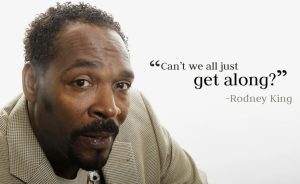
Subsequent analysis of the interview transcript revealed that “Can’t we all just get along?” were not Rodney King’s exact words.
Rather, he said, “People, I just want to say, you know, can we all get along? Can we get along?”
I suppose the precise words don’t really matter. What does matter is that one person – in this case, the actual victim whose brutal experience sparked the whole mess – is calling out everyone to stop and consider what they are doing.
A tale of two realities.
For the past 30 years, Rodney King has been a powerful symbol of the same forces that Dickens embedded in his narrative. A tale of two realities. The ‘best and worst’ always co-exist side by side. ‘Wisdom and foolishness.’ ‘Belief and incredulity.’ ‘Light and darkness.’ ‘Hope and despair.’
All point to the reality that, as a collective humanity, we have the potential for both ‘everything and nothing’ at our fingertips. Worldviews, biases, choices, behaviours. They determine the nature and extent of our respective contribution or hindrance to improving the human condition around us.
Rodney King had reason to be angry. And he probably was. But in the midst of this personal trauma, he rose above his immediate circumstance and invoked a call to ‘best,’ to ‘wisdom,’ to ‘belief,’ to ‘light,’ and to ‘hope.’
Sadly, a simple call to encourage human care and gentleness wasn’t enough. Brute force prevailed to end the Los Angeles riots.
October 21, 1967.
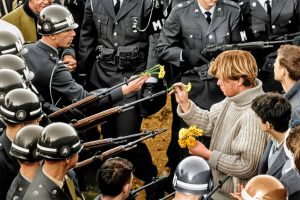
Now dial back from 1992 to October 21, 1967. A march to the Pentagon in protest of the war in Vietnam. Military police are at a standoff with demonstrators.
A young man starts placing carnation flowers into the barrels of M14 rifles. An action captured on film in what has become the iconic 1960s ‘Flower Power’ picture, a powerful symbol of peaceful protest.
Perhaps the new version of Rodney King’s words make even more sense than the first.
If ‘just get along’ is so difficult to achieve in this world of conflict, maybe ‘just want to say’ is the best we can do.
Maybe it comes down to an individual making a statement, however small and insignificant, in the face of power.
Something that challenges the prevailing condition, resets the picture to one of gentle humanity, genuine relationship, and basic goodness.
“Just want to say” and flowers in gun barrels illustrate the strength of human potential. How even one individual can shift the spotlight from mass power to small, but ultimately even more powerful, human actions.
Three more examples come to mind: the Tank Man in Tiananmen Square, Sydney Carton at the end of Dickens’ novel, and Dietrich Bonhoeffer’s final day.
June 5, 1989, in Beijing, China.
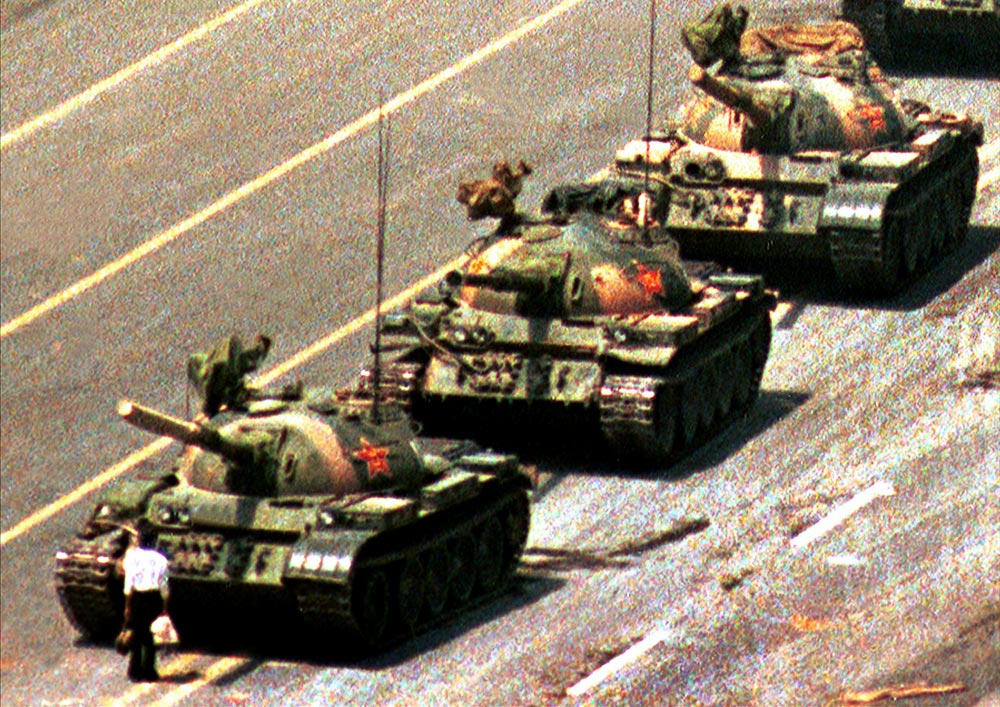
The Tiananmen Square protests lead to a massive government response. Holding what looks like shopping bags, an unknown man steps in front of a line of tanks.
At first the photographer was annoyed. He was trying to get a good shot of the tanks.
But international media were captivated by his ‘Tank Man’ picture. It became a major symbol of an individual’s defiance in the face of violent authoritarianism.
The transformation of Sydney Carton.
In the Dickens novel, Sydney Carton is a rather unsavoury character. Yet by the end he gives himself to die as a substitute for another man.
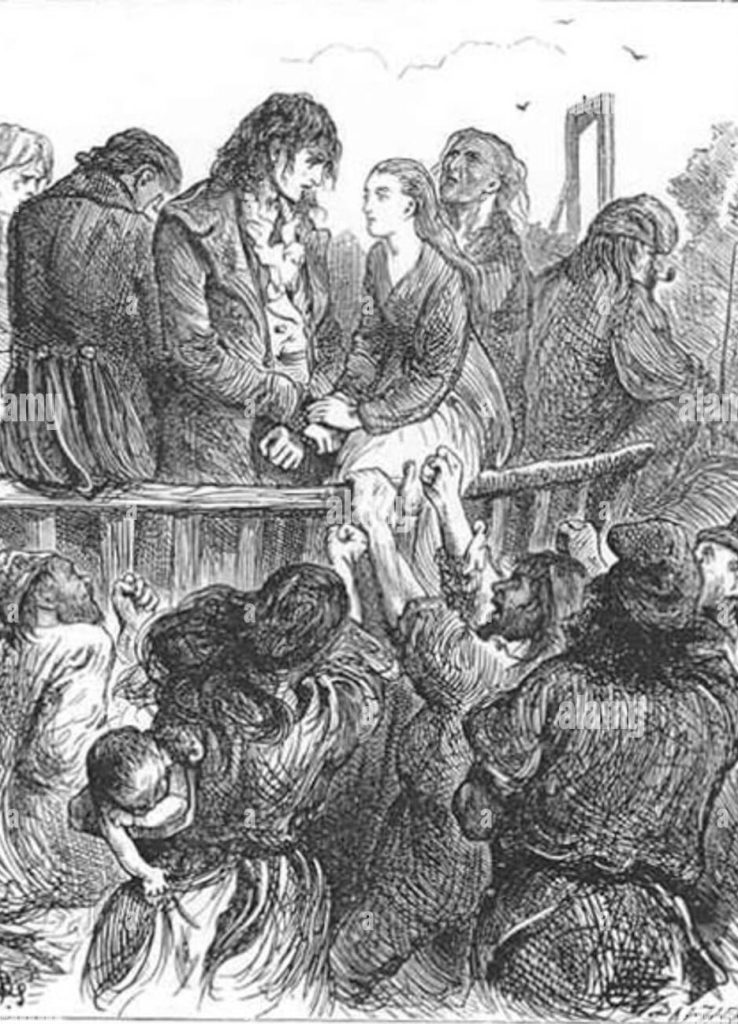
On his way to the guillotine, Carton travels in the same cart as a condemned seamstress. He consoles her fears, comforts the young woman, gives the human touch of a held hand, and offers a parting kiss as she is taken to the guillotine before him. He tells her to look steadily at him and not the ravenous multitude of spectators.
At the end of the novel, Carton’s final words (a silent, internal monologue) offer a powerful moment in English literature. “It is a far, far better thing that I do, than I have ever done; it is a far, far better rest that I go to than I have ever known.” And his final actions vividly embodied those words, and elevated the worst of times to the best.
On April 9, 1945, just weeks before liberation of the Flossenbürg concentration camp, the Nazis executed German pastor and theologian Dietrich Bonhoeffer on a makeshift gallows. Witnesses present at the time have testified to the noble manner in which Bonhoeffer met his end. Throughout his imprisonment, he was seen as calm, at peace, and a constant encouragement to others. On the day of his execution, Dietrich knelt to pray in his cell then was led out to the gallows, pausing on the way to comfort a fellow prisoner. Amongst his final words were, “This is the end – for me, the beginning of life.”
When I was teaching high school English many years ago, one of the prominent themes in the literature curriculum was called ‘Man’s Inhumanity to Man.’ (Back then the word ‘mankind’ was assumed to refer to all people – other than when it was assumed to be affirming a male-dominated society). Humans’ inhumanity to humans. The annals of history are somewhat defined by these dual, conflicting realities. Humans behaving in the most inhuman ways upon one another.
A tale of two realities.
The best of times. The worst of times. I am thankful for writers and other artists through the ages who have portrayed this dilemma so vividly. Worthy of more respect are actual individuals who have risen above the mainstream of simple personal survival. Those who have dared to make a statement, often with their lives, that transcends all authoritarian instruments of control and oppression.
Even in the most disturbing, the most depressing, and the most disillusioning times, it is good to remember that the genuine human touch is really the only true and lasting power.