
Dietrich Bonhoeffer, a Lutheran pastor and theologian in Germany, was killed by the Nazi regime just weeks before liberation of the prison camp by Allied troops. In his relatively brief life, Bonhoeffer set out a path for what he called ‘religionless Christianity.’
It was a call to reject ‘religiosity’ and embrace a living and active faith that includes the whole person and affects every aspect of life.
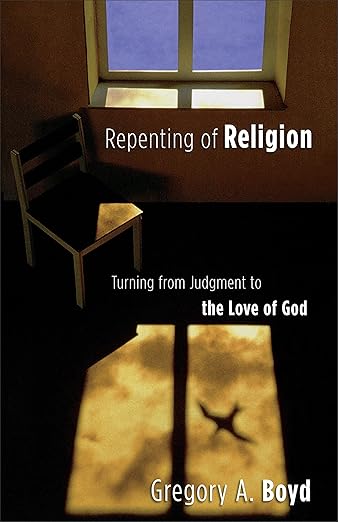
In Repenting of Religion (Baker Books, 2004), Boyd uses Bonhoeffer’s ideas as a challenge to begin practicing a ‘faith-life’ based in love rather than a ‘religious-life’ based on prescriptive doctrines and practices.
From this perspective, he says, “The practice of judgment should be foreign to Christian character.”
If your viewing lens is conservative Christianity, as was mine for most of my life, the following clippings from Boyd’s book should get your attention:
The pharisees of our day will be offended. The church that loves as God loves has to be willing to have their reckless love scorned as compromising, relativistic, liberal, soft on doctrine, anti-religious.
After all, what kind of church attracts and embraces prostitutes, drunkards, gays, and drug addicts? What kind of church routinely has smokers, drinkers, gamblers, and bums ushering during their services, hanging out in their small groups, singing in their choir, signing up for classes, volunteering for ministry and so forth – without anyone immediately confronting their sin? . . . What kind of church blurs the boundary between those who are ‘in’ and those who are ‘out’ to this degree?
The answer, I submit, is a Jesus kind of church.
To love like this, a community has to freed from an obsession with its perimeter – its ability to know or decide who is ‘in’ and who is ‘out.’ It has to be okay with wheat and tares growing alongside each other.
It has to be willing to live in total ambiguity as to who is in and who is out.
It has to live from the center not the perimeter, from the core not the edges.
So, I now either have your attention or you are already gone. Track with me as I summarize the flow of Boyd’s explanation for what gradually went wrong with the Church. He takes it back to Genesis and the Garden of Eden.
When naked and not ashamed, Adam and Eve were free to wander with no restraint other than “Don’t touch the Tree of Knowledge of Good and Evil!” They ate from all the Garden’s fruit including the Tree of Life which provided for a totally fulfilling relationship with each other and with God. The best way to define this relationship was Love.
It is reasonable to ask, “Why not eat from the Tree of Knowledge of Good and Evil?” A simple answer is that they didn’t need to know how to make judgments based on perceived goods and evils. As long as they were totally nurtured by the Tree of Life, such judgments were unnecessary. Everything was screened through the perfect lens of Love. All of that changed, however, with one bite from the Tree of Knowledge of Good and Evil.
Now Adam and Eve are still naked but ashamed. The fruit of the Tree of Knowledge of Good and Evil has given them the ability to make judgments. And God has a problem. He can no longer allow them to eat from the Tree of Life. In the words of Genesis, “The man has now become like one of us, knowing good and evil. He must not be allowed to reach out his hand and take also from the tree of life and eat, and live forever” (3.22).
This new ability to distinguish between good and evil is now the core of their identity. Adam and Eve have separated themselves from relationship with their Creator. [They may not be getting along too well with each other either]. To eat from the Tree of Life and add eternal life to the mix would make them like God but driven by judgment and not love. Another way of putting it is that love doesn’t need judgment but judgment without love is devastating.
Fast forward to today. This ability to judge prevents us, in ourselves, from fulfilling what we were created to be and do, namely to live in loving relationship with God and others. We have displaced God and moved ourselves into the center. And now we ascribe relative value to things and people based on our human judgments of them as being good or not good in our sight. We draw life from the ‘rightness’ of our beliefs and the ‘correctness’ of our behaviour, and judge others accordingly.
You may ask, “So are we trapped in this dilemma?” Is the fulness of what the Tree of Life offered no longer available? Well, in Christian theology, Jesus is the new Tree of Life as represented on the Cross. He becomes the instrument for raising his followers above the limitations of judgment and restoring them to relationships with love in the center. As the new Tree of Life, he supersedes the dehumanizing power of the other Tree. In Christ we become truly and fully human again.
After an extensive biblical study to document his perspective on judgment and love, Boyd shifts to practical implications of the Church’s need to ‘repent from religion.’
With a no-holds-barred approach, he takes on gluttony and homosexuality. In Jewish culture, not controlling your food appetite was viewed on par with not controlling sexual appetite; both were labeled as “shameless passions.” Boyd wonders, “Why isn’t the sin of gluttony portrayed as the sin that makes America a modern Sodom and Gomorrah?” Yet in conservative evangelical churches, “No one questions the genuineness of the faith of overweight people.” They are generally welcomed into church fellowship without any suspicion – even obese pastors! He asks, “Why is this same gracious mindset not extended to gays?” On the contrary, the mindset of most conservative Christians is that the sin of homosexuality is a deal breaker. It defines who is ‘in’ and who is ‘out.’ The genuineness of their faith is more often questioned or even denied.
For Boyd, the essence of life is not found in correct doctrine or pious behaviour. As important as these qualities are, to base life on these things is religion. The community of faith needs to ask forgiveness from God, and from the world, for being religious. We have eaten from the forbidden tree and constructed our own self-serving sin list to determine who’s ‘in’ and who’s ‘out.’ Instead, we are called to turn from our religion of addiction to the tree of knowledge of good and evil. We are called to repent of placing our self-perceived judgments about ‘rightness’ above the command to love.
Repentance (a decision to turn) is the first evidence that we have stopped eating from the Tree of Knowledge of Good and Evil and, through the Cross of Jesus Christ, have begun eating from the Tree of Life. In other words, we can be restored to God’s original intention of true life and fellowship with Him, with Creation, and with each other.