A Starbucks surprise.
You never know what a morning may bring.
It’s 7:00 a.m. and -15° C. Not too harsh but not comfortable either. I was standing outside the tire shop waiting for it to open at 7:30 a.m. Someone offered to hold my spot in line while I went to Starbucks next door for a coffee. Not my usual place. Blonde is the only flavour that is light enough for me.
As I turned from ordering my coffee, I was facing a young woman, likely early twenties, with this assembly of personal products laid out in front of her. A riveting display organized perfectly as if for a sales presentation. Yet it appeared to be her personal array. [She approved of me taking the picture]
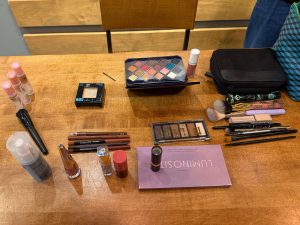
A positive response to my “Good morning” encouraged me to express my curiosity. She kindly gave me a summary overview of the items, most of which was like a foreign language to me.
It felt intrusive to ask why she was doing this in Starbucks at 7:00 a.m. I noticed the fine features of her face and said it didn’t seem that she needed any of these things. Then I added, “But I could probably benefit from some of them myself.”
She smiled and responded that I looked fine without them. [What a fine young woman!]. It struck me how quickly we had established a comfortable conversational exchange. More mutual smiles and I returned to my spot at the tire shop.
My morning array.
That conversation made me think of equivalent accessories in my life. The ‘tools’ that I take for granted every morning without thinking. My personal array.
Two sets of shampoo and conditioner (not shown here), one normal and the other designed to keep my white hair nice and white.
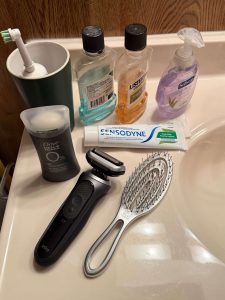
Two kinds of Listerine. I have used the original yukky yellow for 50 years. More recently, I succumbed to adding a coloured version to my palette. There are times when the original is held captive behind the pharmacist counter to prevent undesired alcohol consumption.
Sensodyne toothpaste, preferably mint gel.
Dove 48-hour deodorant with 0% aluminum. The zero aluminum works to avoid underarm colours but the 48 hours is wishful thinking (at least for me).
My Braun Oral-B electric toothbrush. I use it every evening since getting a verbal spanking from my oral hygienist during a teeth cleaning. Having that victory, she did relent and back off from her “Why aren’t you flossing?” lectures. My new problem is a friend who says I should also brush in the morning as well. Will it never end?
My hair brush, on permanent loan from my wife. It doubles as a soothing scalp massager in the morning as I create a minimized version of ‘the Fonz’ look.
My new Braun Series 7 electric shaver which I reported on in How much is enough? . . . Sometimes ‘less is more,’ March 25, 2026. It has proven to be a good purchase. No regrets.
I see the SoftSoap squirt bottle made it into the picture. It is less messy at the sink than bars of soap. In the shower I do use a soap bar – Dove (with one-quarter moisturizing cream). My wife asked me to switch to body wash which supposedly leaves less scum on the shower door. It doesn’t feel the same.
Does Quasi really work?
Watching a news report recently, I refrained from hitting the ‘Skip’ button after an advertisement cut in. An animated ad with catchy music enticed me into the world of Quasi salmon PDRN collagen masks. Doing a bit of research, I learned about K-Beauty, the world of skin care and makeup products from South Korea.
Would the Quasi work on 78-year-old Ukrainian skin?
Digging a bit further, I found the same conflicting evidence as with so many other ‘guaranteed’ facial-feature-enhancing products. For every zealot there was also a critic. I’ll take a pass on getting the mask (at least for now).
But, the lingering question.
The question remains, “Why is an attractive young woman in Starbucks at 7:00 a.m. focused on such an armoury of personal skin products?”
She is certainly in the mainstream of normal human behaviour. Average annual spending per person for skincare products is $500 ($600 for women) plus $400 for hair products. Expanding to “the entire personal care ecosystem,” Canadian households spend, on average, $1,900 annually for cosmetics, hair care, and hygiene products.
So then, why?
Without consulting any of the experts in this area, I offer one simple observation: Most of us are interested in, and concerned about, how we look.
Some may call it vanity. And those who spend way more than the national averages might be functioning from that motivation. But, for most of us, it is simply normal human behaviour. Two examples will illustrate.
One personal and one religious example.
I used makeup for a while. Yes, I did. My years as the leader of an organization were very demanding. One undesirable external side effect was rosacea, a red rash on either side of my nose. It was fairly minimal but, for my public persona, I was not a pretty sight. Yet I still had to attend conferences, give verbal reports, have one-on-one meetings.
In desperation, I consulted my wife for assistance. She offered a bottle from her makeup shelf with ‘earth-tone’ in its name. For weeks, it would have a prominent place beside the rest of my morning array. I was just getting pretty good at applying it when the need receded.
Thus, not just theoretically but also from personal experience, I approach this subject with a distinct no-judgment attitude.
My second example will either amuse or infuriate you. It rises from the legalistic behavioural norms that some religious groups apply to their people. But it also shows you the ability of individuals to rise above their own culture and recognize what I am calling normal human behaviour.
So, do withhold your judgments of moralism and sexism if you can. And offer a smile that some people, even within rather restricted contexts, can still see beyond the straitjacket. Even if it is expressed in sexist terms. Give them time to learn more before you squash them. And, with that lofty introduction, here is my example.
Strict religious groups often legislate against women, especially young girls, using makeup. One of our long-term female friends grew up with this undesired mandate and chafed, along with all her girlfriends, at such a requirement. Speakers at summer camps usually re-affirmed such behavioural norms in the name of holiness.
One summer when she was in mid-teens, her relationship to makeup was dramatically liberated and transformed. A camp speaker addressed the matter of makeup and uttered a statement that shook the room: “A farmer takes stock of the condition of his buildings. And if the barn needs painting, he paints it!”
You never know what a camp meeting, or an early morning at Starbucks, may bring.