
Cherished memories.
This dvd of Fiddler on the Roof waits expectantly on my bookshelf, ready to be of service again. My daughter and I have precious memories of multiple viewings together. Each time, the musical drama took us on a journey through a full range of human emotions.
As the final scene faded out, we would sit with a renewed sense of awe at the powerful simplicity of its core theme: We dare not lose the music in life.
Fiddler on the Roof.
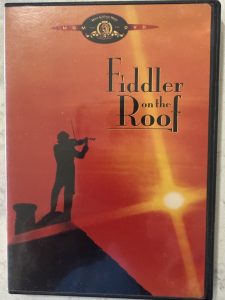
The main character, Tevye, has suffered many hardships. He sings ‘if I were a rich man’ but is quite aware he will always have a life of poverty. His daughters have greatly disappointed him by marrying men not of his choice.
His community of people are repeatedly turfed out of their ramshackle homes by soldiers who ride in, trash everything, and force them to move again.
Tevye, a devout Jew, is even disappointed with God because of all his troubles. An iconic line in the play is, “God, I know we are the chosen people; but can’t you choose someone else some of the time?”
The fiddler is an intangible figure who externalizes a vital element of life for Tevye and his people. His music represents the irrepressible human spirit of hope, energy, and faith in the future. It draws the people together in unity and community.
The soldiers have destroyed their homes and forced them to move again. Tevye’s youngest and last daughter is leaving to marry a man not of his choice. Full of anguish from all his troubles, Tevye is glumly packing his wagon to hit the road again.
While tightening the wagon straps around his meagre belongings, Tevye hears the squeak of a violin. He looks to where the fiddler is standing on a rising crest in the road. The violin and bow in his arms are now hanging to the ground. His silhouette is framed by the sky.
There is silence. Tevye looks at the fiddler. The fiddler looks at Tevye. Back and forth. Finally, Tevye sighs, raises his arm, and signals the fiddler to come down and join them on the journey to their next unknown place. The fiddler jumps up and dances towards Tevye, joyfully playing his violin.
Don’t lose the music!
I love this moment in the drama. Tevye is so tempted to tell the music to stay away, to leave him alone. Life is too hard. The challenges are too big. He has no room for a song, for optimism, for faith in the future. But he realizes that, without the music, life is not worth living.
The music, the effervescent primal force of fuel and fire and faith that continually finds pathways to erupt from the depths of the human spirit. Despite all the harsh realities that strive to quench its existence, the music is ultimately a stabilizing influence for Tevye and his people to maintain the will to go on.
And, when the final credits roll and I want some time to just sit in silence, I realize again how true that is for all of us.
The beauty of catharsis.
Think of a movie that has pulled you apart inside. Everyone is leaving and you continue to sit and stare at the blank screen. Something has moved inside you. All kinds of sensations, feelings, and thoughts are swirling around. Eventually your companions nag you into leaving.
What has happened?
The marvels of the script, the plot, the music, and actors have taken you on a journey through what the Greeks called ‘purification’ or ‘cleansing’ of the soul. You have allowed all the elements of the movie to convince you to do what the poet Samuel Coleridge called “the willing suspension of disbelief.” You entered fully into the drama as if it was real and it had a very real impact on you.
The net effect of this emotional, often rollercoaster, ride is a new sensation of heightened awareness of life. And, even if just for a few moments, you actually feel lighter and better and more in tune with being alive.
There is a backstory to this common human experience.
The Greek philosopher Aristotle used ‘catharsis’ to describe the potential impact of tragic drama. We are captivated by the characters dealing with the conflicting forces of life, especially suffering. Through them, we vicariously experience a full range of human emotions. The dramatic journey enables a release and ‘purging’ of those emotions that is draining but also refreshing.
There may even be times when such experiences can serve as cheap therapy. In Shakespeare’s day, the common people paid one penny – a day’s wages – to stand in the open pit before the stage. They looked for relief from the desperation of their own suffering. Many of them brought rotten tomatoes to express the ‘purging’ of their emotions. Perhaps contemporary models of counselling could learn something from them.
Back to the music.
Today, music plays a large role, for better or worse, in shaping our collective response to products in the marketplace and ideas in society as a whole. It is also part of a broader range of artistic expression that has therapeutic value for human needs.
Art cure: The science of how the Arts save lives (2026).
Daisy Fancourt puts together decades of science-based research to show how, “from cradle to grave, engaging in the arts has remarkable effects on our health and well-being . . . [and] improves the functioning of every major organ system in the body, even helping us live longer.” This is a large claim to make.
Fancourt backs it up with statistics from volunteer participants tracked over multiple years. The data shows how music (and other arts activity) has tangible positive effects on dementia, depression, emotional awareness/regulation, stress management, alzheimer’s, parkinson’s, brain injuries, and strokes recovery.
It is a jaw-dropping experience to read page after page of results from credible, world-wide studies by a multitude of researchers. Here is one example.
Starting with the cradle.
New mothers experiencing postpartum depression volunteered for placement in two groups. One group enjoyed fun time together but without any artistic activity. The other group learned new songs to sing with their babies and wrote new songs together about their experience of motherhood. Both groups met weekly for 10 weeks.
Within six weeks, 2/3 of the music group were no longer classified as having postpartum depression. One mother told Fancourt how her life had been completely on hold. “In the throes of postnatal depression, I barely noticed my daughter . . . But the singing classes turned everything around and brought me back to her.” The other group had some improvement but not nearly that of the music group.
The fiddler is in you!
Tevye did not need to find extra room in his wagon for the fiddler. One wave of his arm reunited Tevye’s will and spirit with everything the fiddler represented. The music embodied the wonder of life, the commitment to hope, to trust, and to faith in the future. All these precious and essential elements would be alive and well inside him no matter how difficult the road ahead.
Don’t lose the music. It’s who you are.